
Mertens' Water Monitor
Varanus mertensi
Australia's Threatened Species Category
Endangered
Listed since: 21/12/2023
IUCN's Threatened Species Category
Endangered
Listed since: 20/02/2017
Population trend: Decreasing
Other names: Mertens's Water Monitor
Priority species? No
The Australian government's Threatened Species Action Plan 2022-2032 selected over 100 priority species derived from consultation with threatened species experts and the wider community. While all species are important, focusing on a limited number of species can help target effort and resources so that outcomes can be achieved, measured and shared.
Description
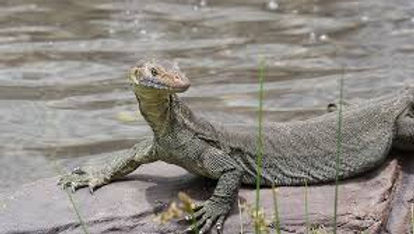
Mertens� Water Monitor is a large and robust lizard that reaches up to 1.5m in total length. It is a semi-aquatic monitor that is well adapted to the water, having nostrils positioned on top of the snout and a long, strong tail for powerful swimming. It occurs patchily across tropical northern Australia, from the west Kimberley in Western Australia, across the Top End of the Northern Territory, to the wet tropics in far north Queensland. It usually eats freshwater crabs, fish, insects, amphipods, spiders and frogs, however, it will also consume most invertebrate and small vertebrate prey that can be subdued, including shrimps, crayfish, aquatic snakes, lizards, nestling birds, small mammals, caterpillars, and eggs.
Threats
The greatest threat to the long-term persistence of Mertens� Water Monitor is the invasive and toxic cane toad. Although they appear to be persisting across the Top End of the Northern Territory, there are few remnant sites elsewhere within this species� distribution where cane toads have established.
Quollity Conservation Hub's Overall Priority Score
Average life span:
Unknown
Number of young produced each year:
Unknown
Number of breeding events each year:
Unknown
Minimum sexual maturity age:
Unknown
Who is helping
Useful links for more detailed information on this species
DCCEEW - Australian Government Department of Climate Change, Energy, the Environment and Water
SPRAT - DCCEEW Species Profile and Threats Database