
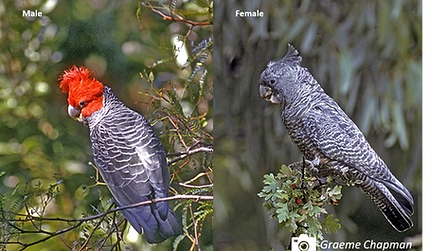
Gang-gang Cockatoo
Callocephalon fimbriatum
Australia's Threatened Species Category
Endangered
Listed since: Wed Feb 02 2022 14:00:00 GMT+0000 (Coordinated Universal Time)
IUCN's Threatened Species Category
Vulnerable
Listed since: 11/17/2021
Population trend: Decreasing
Other names: None
Priority Species? No
The Australian government's Threatened Species Action Plan 2022-2032 selected over 100 priority species derived from consultation with threatened species experts and the wider community. While all species are important, focusing on a limited number of species can help target effort and resources so that outcomes can be achieved, measured and shared.
Description
Gang-gang Cockatoos are a small, stocky cockatoo, which are socially�monogamous, with pair bonds lasting many years, and make their nests�in tree hollows.
Threats
Habitat is critical to the survival of the Gang-gang Cockatoo who favour old growth forest and woodland for nesting and roosting. This species is an altitudinal migrant and in summer months, Gang-gang Cockatoos generally occur in tall mountain forests and woodlands and during winter months, they rely on drier more open eucalypt forests and woodland at lower altitudes.
Quollity Conservation Hub's Overall Priority Score
53
Average life span:
Number of young produced each year:
Number of breeding events each year:
> 10 yrs
Couple (2-3)
One
Minimum sexual maturity age:
2 - 5yrs
Who is helping?
Useful links for more detailed information on this species
DCCEEW - Australian Government Department of Climate Change, Energy, the Environment and Water
SPRAT - DCCEEW Species Profile and Threats Database
Gouldian Finch
Erythrura gouldiae

Australia's Threatened Species Category
Endangered
Listed since:
IUCN's Threatened Species Category
Least Concern
Listed since:
Listed since:
Description
Description
The Australian government's Threatened Species Action Plan 2022-2032 selected over 100 priority species derive from consultation with threatened species experts and the wider community. While all species are important, focusing on a limited number of species can help target effort and resources so that outcomes can be achieved, measured and shared.
Description
The Gouldian Finch are vividly multi-coloured with about 75% having black faces. They can be found from Cape York, the north of the Northern Territory to the Kimberley Region of Western Australia. Gouldian finches feed almost exclusively on grass seed and depend on a small number of grass species at different times of the year. They nest in tree hollows and produce 1-2 fledlings per season.
Threats
Vegetation change through altered fire regimes and grazing by introduced herbivores are the factors that have most likely caused the decline in this species and is preventing recovery. Heavy grazing by cattle is known to reduce seed yields in grasses which is an important food source for the Gouldian Finch.
Quollity Conservation Hub's Vulnerability Score:
57
To help compare the relative vulnerability of different species, we have developed a scoring system based on biological and ecological characteristics that influence a species' ability to survive and recover from environmental change and natural disasters.
The framework is adapted from assessment methods used by conservation experts following the Black Summer bushfires to help identify species most in need of conservation action, research, and recovery funding.
Each species is assessed using a range of factors, including its conservation status, lifespan, reproductive rate, habitat and dietary requirements, ability to disperse or recover after fire, and the number and severity of threats it faces.
In general, the higher a species' score, the greater its overall vulnerability and risk of decline or extinction.
Like all conservation assessments, this scoring system is limited by the information currently available. Many threatened species remain poorly studied and receive limited research funding, meaning some assessments rely on the best available scientific knowledge or information from closely related species. As new research becomes available, scores may be updated to reflect our improved understanding.
Average life span:
Number of young produced each year:
Number of breeding events each year:
Minmum sexual maturity age:
> 2yrs and < 5yrs
Few (>3)
< 1yr
Who is helping
Useful links for more detailed information on this species
DCCEEW - Australian Government Department of Climate Change, Energy, the Environment and Water
SPRAT - DCCEEW Species Profile and Threats Database